
.jpg)
Blogs
Complete Bean Buyer’s Guide: How to Select Black, Red Kidney, Green Lentils, Pigeon Peas, Cowpeas, Yellow Beans and More
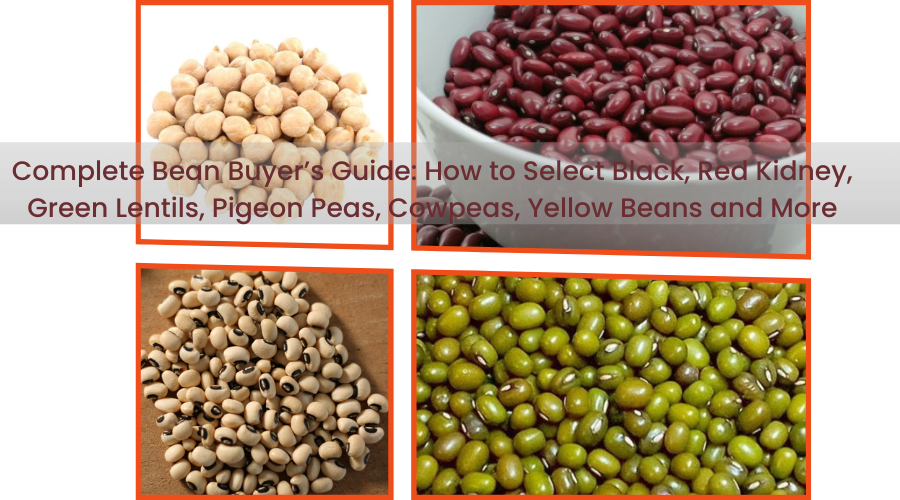
Almost every country requires legumes like lentils, beans, and peas in massive volumes. The demands are massive since these types of foods provide high plant-based protein, minerals, and fiber. Even the canned beans and lentils require a raw supply for production. They look for bulk soya beans, kidney beans, cowpeas, chickpeas, and kidney beans at a low price. The food chain is enormous, and regions like Asia, Africa, and South America are the largest consumers of legumes. Even their byproducts are many, which further expand the market size. So, this blog is for bulk buyers like importers, distributors, restaurants, catering businesses, and canned food manufacturers.
A Brief Guide to Select Beans, Peas, and Lentils
If you are new to this industry, this brief guide can make your legume selection process simple. All you need to do is know some considerations that can help you inspect the seeds carefully. You will have to do visual and physical inspection of beans, peas, and lentils to prevent flaws in the selection process. You can avoid procuring rotten, stale, shallow, and moist legumes, especially when buying soya beans.
Soybeans
What people usually look for is protein, fiber, and oil content, but there is more than that. You should inspect the seed size and its consistency first. Look for a size range between 6.5 mm and 9 mm in length, and 5 mm and 7 mm in width. It will help you choose the standard seed size when buying bulk soya beans.
Besides, they must have low moisture content because excess moisture can cause staleness in them. Besides, the foreign materials like stones and chaff have to be a few percent only. You will find the percentage level in the key factors section of this blog’s second half. Then comes the appearance where the color must be uniform. Since soybeans are found in different colors depending on the region, you can find them in white, pale, green, yellow, and black colors.
Black Beans
If you are about to procure black beans, you should know how they appear. Their appearance
must be shiny and jet black. A black bean has a white keel in the center and a full jet-black body. So, you will have to keep the color in mind when buying black beans in large quantities.
Avoid the ones that have tiny holes and white spots. Also, do not choose broken ones until the broken percentage is very minor. You can find that percentage later in the blog. Also avoid dull and faded beans, which will indicate the internal flaws in the beans.
Make sure you choose the size of black beans of 10 mm length and 5 mm width. The size could vary a little depending on the type you choose. Search for consistency in color, size, and shape because black beans have a uniformly oval shape or a slightly kidney shape.
Red Kidney Beans
These ones are the largest in size. So, you will easily detect them among other types. When choosing red kidney beans, search for deep red beans in color. They have reddish brown and brownish red shades. Their surface should be smooth and plump. They must not contain debris or holes.
Their sizes are around 15 mm in length and around 7 mm in width. They must not be dry and thin because the fresh ones are mostly hard and plump in appearance. If you notice any defects like discoloration or spots, avoid those red kidney beans.
Green Lentils
Then some people find it difficult to choose fresh green lentils. Here are the tips for such buyers. Green lentils have an olive green or pale yellowish green color. They have a matte surface and lens shape, which is easy to notice.
If you look at the grain size, it ranges between 4.5 mm and 7mm in diameter. Just make sure they do not have debris, stones, or pecks, which will only be signs of foreign materials. Their smell is earthy and dusty if you closely inspect it.
Red Lentils
There is another type of lentil, which is red lentil. These lentils have a vibrant orange-red color in appearance. So, you will have to look for color and shape consistency when selecting them. They must be dry at the time of selection because if you notice tackiness in them, that means they have high moisture.
So, you need to choose non-tacky red lentils by physically inspecting them. Besides, their size ranges between 4.5 mm and 7mm in diameter. They must not have a strong odor, which will signify the staleness. The fresh ones have an earthy and dusty smell.
Pigeon Peas (Arhar Lentils)
Some people call them pigeon peas, and some call them arhar lentils. They have a light brown and beige color consistency, which means you need to focus on color first. They must not have black spots and discoloration, because these are the signs of bad quality.
If you look at the shape, arhar lentils have an oval shape. Their length ranges between 5 mm and 7 mm, and their width ranges between 4mm and 5mm. The fresh pigeon peas have brittle structure because if you find soft ones, that means they are moist inside. They also have an earthy and dusty smell when they are fresh.
Cowpeas (Black-Eyed Peas)
Then we have cowpeas, and they are also known as black-eyed peas. The reason why we call them cowpeas is that they are usually cows’ feed. Also, the term came from their appearance because their hilum looks like eyes. If you are about to choose them, look at their spherical and kidney-like shapes. They have a creamy white structure with a black and white hilum, which appears like an eye.
Cowpeas have a smooth surface that is dry, hard, and plump. Their sizes range between 5 mm and 11 mm in length and 5 mm and 7 mm in width. Just make sure they do not have holes, molds, or dark spots on them. Also, they must not contain powder in their bags, which is a sign of higher foreign material.
Chickpeas (Kabuli Channa)
If you are going to select chickpeas or Kabuli channa, here is what you will have to notice. They have a beige color, mostly with a hazelnut-like shape. They are larger than most lentils, peas, and beans. This is why their sizes range between 4 mm and 14 mm in diameter. You will also find them available in small, medium, and large sizes, so do not get confused regarding the sizes.
You can sniff them and inspect their freshness if they have a nutty and earthy smell. Make sure they do not have dark spots and discoloration because these are the signs of infestation. Also, they must not contain pinholes because they show they are shallow inside.
Yellow Beans
Since beans are found in lots of types, here is another popular type, which is the yellow bean. You can already have an idea about their appearance through their name. They have a yellow and light-yellow color range with high consistency. They have a kidney-like or oval shape if you closely inspect. Their hilum is white, and the overall appearance is plump and shiny. Even their size is similar to that of soybeans and black beans, with high consistency.
Just like the others, they also must not have white, brown, or black spots. If you want to avoid having a high broken percentage, avoid the ones with very light, broken, and shallow structures. You can smell them to inspect the nutty and earthy smell that indicates freshness. Any other smell, like the musty one, is a sign of high moisture and staleness.
Moong Beans
Many consumers like moong beans, which means wholesalers or importers would like to know about it. If you are one of them, you need to know how to detect the freshness in moong beans. The fresh ones have a vibrant olive-green appearance. They have consistent gloss and hardness. In terms of sizes, you will find them smaller than others. This is why their length ranges between 4 mm and 5 mm. Their width ranges between 3 mm and 4 mm.
You need to find uniformity in shape and color if you want fresh moong beans. The fresh ones have an earthy and nutty smell. Just make sure they are free of any holes and spots.
Key Factors That Define the Quality of Legumes
To make the selection process simpler, here are key factors to look for. Procuring bulk soya beans or any other pulse will be easier by following these factors. Importers and wholesalers that need bulk lentils, beans, and peas need to have a look at these considerations.
Size
Every bean, lentil, and pea is different from others, even if they appear slightly similar. You will have to closely monitor the size of a sample to ensure you are buying high-quality beans, lentils, and peas. In the above section, we shared size ranges of each type for your convenience. You can follow them to select the standard quality that is safe for all.
Color
The same is for color consistency. Each lentil, bean, and pea have a different color. Some are white, black, green, red, beige, and yellow. The colors vary depending on the type. You must know about the standard color range of the type of legume or pulse you are buying. If the color is different from the standard range, it means there is something wrong with the quality. Avoid the ones with discoloration, spots, and pinholes. They are the signs of infestation, staleness, and other problems.
Water Test
Perform a water test on the sample to test if the beans/peas/lentils are fresh. You need to dip them in a bowl of water to test their freshness. If they settle down easily, they are fresh and safe. If they float, it means they are damaged, stale, or hollow from the inside. You can perform the same test on a sample when procuring bulk soya beans.
Moisture Level
The moisture level should be a maximum of 12%. Some follow 14%, but it should be less than 12% for better freshness. Whether you are purchasing bulk soya beans or any other legume, the rule is the same for all. Another thing you can do to inspect moisture level is by shaking the bag of samples. If the lentils/beans/peas are fresh, shaking the bag will make a rattling sound.
Low Foreign Materials and High Purity
Foreign material is about dust particles, stones, and pecks. These foreign materials should be a maximum 2% only. If you notice the rate is higher than it is, you will have to ask for better quality.
Broken Percentage
Then comes the broken percentage of beans, lentils, and peas. It should be between 3% and 5%. There are some broken units of peas, beans, and lentils, which are acceptable only if they are within 5%.
Leading Sources of Beans, Lentils, and Peas
You might be wondering about the leading countries that supply beans, lentils, and peas. It will be better for you if you know about them because your supplier probably procures from any of these countries. Before you procure bulk soya beans, mung beans, red beans, or any other type, you need to know about them. The following are the countries that have the largest production of legumes and lentils in the world.
• India
• Brazil
• Myanmar
• Ethiopia
• Russia
• Tanzania
• South Africa
• USA
SK Logistics International sources its beans, lentils, and peas from some of the above countries. As a result, its customers get fresh, safe, authentic, and healthy legumes of different types.
What Makes These Countries a Better Source of Beans?
It is about their soil, climate, and quality assurance in the production process. These legumes, like beans, lentils, and peas, grow well in well-drained and loamy soil. They need soil PH between 6 and 8. Even the moderate salinity is suitable for them for stable growth.
Waterlogging is not good for lentils, which is why these countries are good at maintaining consistency in their farming practices. They grow well in temperatures between 15 degrees C and 24 degrees C. A cool climate is suitable for lentil production, which is why SK Logistics sources legumes in large volumes from them.
Conclusion
To get the best quality of beans, lentils, and peas of different types, you need a reliable supplier. That supplier either has its own production or has a reliable source to procure in bulk. SK Logistics sources multiple types of beans, lentils, and peas to supply globally at a low price. Since you know how to inspect the quality of bulk soya beans and the rest of them, all you need to do is connect with a supplier. You can then ask for a sample to inspect the quality, and then go ahead of bulk order. Once you get consistent quality and an affordable price, nothing will be better than partnering with such a supplier.
Recent Post
Choosing an edible oil supplier is a decision that directly impacts the profitability of
READ FULLThe global demand for sunflower oil, kernels, and seeds is massive. The farming, cattle,
READ FULL