
.jpg)
Blogs
How to Source High-Quality Edible Oils: Sunflower Oil , Virgin Olive, Cotton Seed, Corn & Refined Oils from South Africa
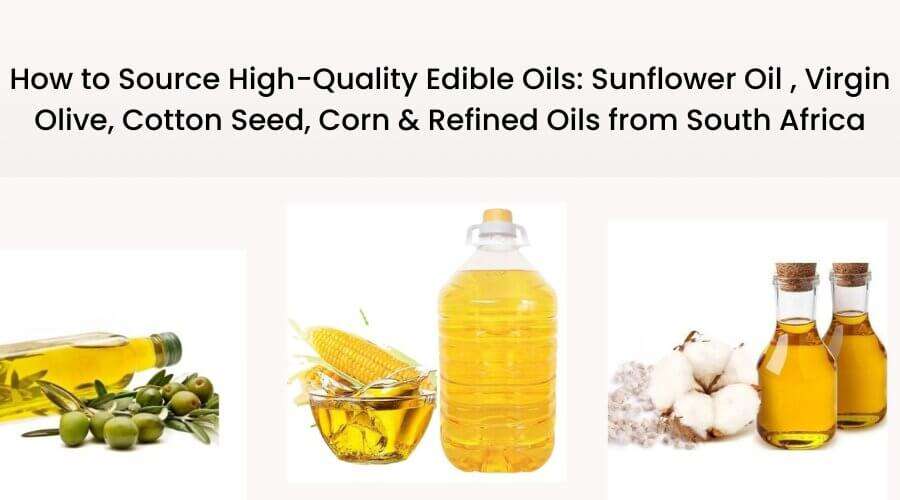
Choosing an edible oil supplier is a decision that directly impacts the profitability of any trading and exporting business. It affects the product quality, and can either strengthens or fracture your supply chain. Global vegetable oil consumption has surpassed 220 million metric tons annually, as indicated by USDA marketing data, meaning stakes are high!
For the food manufacturer, importer, or wholesaler, creating and maintaining a competitive edge in today’s market requires having access to edible oils that provide something other than just a lower cost per ton. Manufacturers today seek quality consistency, reliable shelf life, protocols for food safety and logistics agility from their oil wholesaler partners and feel that supply chain stability along with flexible packaging are both requirements, not negotiable terms.
That’s where South Africa enters the picture.
Why South Africa Is a Strategic Market for Edible Oil Sourcing
South Africa’s role in the edible oil landscape has many sides. In addition to being an established regional market, it is also a sophisticated food processing center and a global logistics hub with major ports like Durban and Cape Town. This combination creates a unique edge for B2B buyers.
Think about the operational realities you face. You need access to both packaged and bulk oils without navigating a maze of intermediaries. You require warehousing and redistribution networks that can move product efficiently across borders. A competent South African edible oil supplier brings all of this to the table, coupled with a close familiarity with the export documentation required for seamless customs clearance. They offer private-label and customized packaging options that allow your brand to stand out, whether you serve the hospitality sector or the retail space.
The demand drivers are also quite stable. There are numerous large-scale food manufacturing and fast-paced hospitality businesses that need a reliable oil supply continuously. A supplier who understands the consumption cycle and offer multiple services like provide samples for lab verification, managing packaging inspections, and navigating a rigorous supplier onboarding process is worth more than a low quote. This is the level of operational knowledge that separates a vendor from a true partner.
What Buyers Should Check Before Choosing an Edible Oil Supplier
A reliable supplier doesn’t just sell oil; they provide a framework of trust. Most advice stops at “find a reliable supplier.” Let’s get into the how of verifying that reliability.
Check for Quality Certifications
Your due diligence should start with certifications. Some worthy certifications that are must-haves include food safety quality marks like ISO 22000, FSSC 22000, and HACCP. Depending on your target market, Halal and Kosher certifications should also be a top priority. These aren’t just badges; they represent a commitment to process control.
Documentation
A serious supplier will present you with the Certificate of Analysis (COA) and a product specification sheet as soon as you make the request. They’ll supply phytosanitary or health certificates where needed, clear origin documents, and allergen declarations. This paperwork is your first line of defense.
Commercial Check
Commercial checks form the next layer of supplier verification. Get clear confirmation regarding Minimum Order Quantities (MOQ), lead times, and packaging options. These can range from tankers to flexitanks and drums. Next, get clarity on payment terms and Incoterms upfront. Finally, and most critically, define your quality checks. This goes beyond a simple visual inspection. You need to verify the refining level, odor, and color consistency, alongside critical chemical indicators like peroxide value, free fatty acids (FFA), and contaminant screening. A supplier who cooperates with you in this commercial check means a supplier who has nothing to hide. And if the supplier is hesitant than that means you are dealing with a supplier that is only offering a cheap price and nothing more.
Premium Edible Oil Varieties in High Demand
Sunflower Oil
Sunflower oil remains a core part of the global edible oil trade. Its neutral taste and light texture make it a versatile oil that has wide applications. It is suitable for everything from high-volume frying and snack production to baking and household cooking.
For buyers, the conversation should center on specific applications. Are you looking for a refined, deodorized spec? What is the fatty acid profile? What are the guaranteed peroxide value and the shelf-life? The answers to these will determine whether that shipment will perform according to your expectations or not.
Cotton Seed Oil
Cotton seed oil occupies a specific, valuable niche. It is a versatile option, often used in frying blends, processed foods, and margarine or shortening applications. Its value lies in its flavor neutrality and oxidative stability, which can make it a cost-effective alternative to sunflower or soybean-based oils in certain industrial food manufacturing contexts.
For the commercial kitchen or the production line, consistency is king. This is where cotton seed oil has a competitive edge. However, a word of sourcing caution: buyers must confirm contaminant and residue testing and review refining documentation with particular care. The oil’s upstream raw material demands a higher level of scrutiny, and a trustworthy supplier will have the lab reports to prove they’ve met food-grade safety standards.
Refined Oil from Turkey
For South African importers and distributors, comparing supply origins is a standard part of procurement. Turkish refined oils are a top choice because they have high demand in regional markets of Mediterranean and Eurasia.
When you compare Turkey-origin oils with South Africa-based sourcing, the evaluation comes down to a few crucial factors like freight efficiency, lead times, port access, and the quality of documentation. Turkish suppliers have special expertise in the production of refined sunflower oil, olive oil, and blended edible oils. For buyers, this is a comparative sourcing option, not a replacement for the local advantage.
Pure Refined Sunflower Oil
Refined oil is in a class of its own compared to the generic sunflower oil. This is a product is defined by its higher clarity and standardized refining process. These qualities make it a perfect fit for buyers focused on retail bottling or large-scale foodservice.
The specifications are demanding to fulfil. They include a clear appearance, low FFA, low peroxide value, and a completely neutral odor. Under correct storage, it delivers a long shelf life. Bulk buyers have a preference towards pure refined sunflower oil because it guarantees stable performance and has broad consumer acceptance worldwide. It’s the oil that simply sells, consistently, which is precisely what you need when placing bulk orders for private-label goods.
Virgin Olive Oil
Virgin olive oil is classified in the premium tier. The manufacture of virgin olive oil involves mechanical extraction and minimal processing, which preserves a stronger aroma and a more complex flavor profile. This is the oil for dressings, marinades, premium retail shelves, and gourmet or health-focused food categories.
Quality evaluation of this edible oil is judged by inspecting several factors like acidity, harvest freshness, variety and sensory profile. Because it is light and heat sensitive, the handling and storage facilities should be top-notch. The market of virgin olive oil is notoriously volatile. International Olive Council data show that annual olive oil production fluctuates significantly by crop year. This unpredictability has a major impact on procurement timing and price planning. For South African buyers, imported or regionally packed virgin olive oil opens up a new target market, that of premium hospitality and retail segments. But to succeed in this niche requires a reliable supply chain that is managed with precision.
Corn Oil
Corn oil is a familiar edible oil used in frying, snack manufacturing, and commercial cooking. It has a mild flavor and performs reliably in frying activities. It is commonly available and is a staple for institutional buyers, food manufacturers, and foodservice distributors.
When procuring corn oil, your main concerns should revolve around four aspects: the refined grade, anti-foaming performance, oxidation stability, and the packaging format. Compared to sunflower oil, corn oil offers a similar taste neutrality but the price tier is different.
Essential Quality Metrics for Bulk Edible Oils
Fatty Acids Composition
The fatty acid profile of an oil dictates stability, flavor, nutritional positioning, and the applications for which it’s best suited. As a buyer, make sure to verify the levels of saturated, monounsaturated, and polyunsaturated fats present.
Sunflower oil is generally higher in polyunsaturated fats. In contrast, olive oil is richer in monounsaturated fats. Always request a full fatty acid breakdown on the COA, and reference Codex standards as a baseline for your own quality checks. This is your assurance that the oil you’re buying is the oil you’re expecting.
Free Fatty Acid Content
Free fatty acids are a simple but powerful indicator. In plain language, a lower FFA generally signifies better refining quality and fresher raw material handling. It directly impacts shelf life, taste, odor, and processing performance.
A high FFA can signal issues that started with the seed and continued through storage. This is why professional buyers set acceptable FFA ranges in their procurement contracts. It is a common and justified, practice to reject shipments when the FFA exceeds the agreed-upon specs. This isn’t about being difficult; it’s about protecting your final product.
Peroxide Value
While FFA tells you about raw material quality, peroxide value is the indicator of oxidation. It is basically a measure of the freshness of the product. A low value means that the product will expire quicker. And that means a shorter shelf life.
Your job is to compare the supplier’s results against your contract specs, the shipment date, and the expected storage conditions. Peroxide value should be checked pre-shipment, and for large or critical orders, post-arrival sampling is a non-negotiable best practice. It’s one of those details that procurement teams rely on, and a detail that many generic blogs overlook.
Microbial and Contaminant Testing
Refined oils are low-moisture products, which eliminates some microbial risks. But testing for contaminants is still crucial and forms a vital part of food safety protocols. Your checks should include pesticide residues, heavy metals, mineral oil contamination, and any signs of adulteration. Special-risk screening becomes necessary in certain contexts. A well-informed buyer usually relies on third-party lab verification.
Certifications, Compliance, and Documentation Required for International Buyers
The journey from supplier to your facility is paved with paperwork. A serious supplier will provide a comprehensive suite of documents: the Certificate of Analysis (COA) , Certificate of Origin, invoice, packing list, and any required export permits. Food safety certificates are the final piece of this puzzle.
For private-label buyers, the documentation extends into the physical product. That means making certain that packaging standards are met. This means confirming about bottle sizes, barcode readiness, and whether labeling is clear and informative.
Bulk Packaging Options for Edible Oils
The packaging you choose is more than a container; it’s a critical component of your supply chain. There is a wide variety of choice in terms of packaging options ranging from PET bottles and jerry cans for retail and smaller foodservice, to drums, and flexitanks for bulk handling.
Your choice here will affect the cost per unit, the shelf life of the product, handling ease and the risk of contamination during transport. The right choice is rarely the cheapest. It’s the one that aligns with your destination, your turnover rate, and the storage infrastructure you have in place.
Common Mistakes Buyers Make When Sourcing Edible Oils
Experience is often the best teacher, but it’s a costly one. Many buyers still make the mistake of choosing the cheapest supplier without ever reviewing the lab specs. They ignore oxidation and shelf-life indicators until a shipment arrives rancid.
Others fail to confirm packaging compatibility, only to find that their filling line isn’t equipped for a new bottle format. A surprising number overlook the regulatory and customs documentation until their cargo is sitting in a bonded warehouse. Perhaps the most common error of all is buying without a signed technical specification agreement. Without that document, you have no baseline for quality and no recourse if the product fails to perform.
Why Trusted South African Suppliers Stand Out
In this complex landscape, trusted South African suppliers differentiate themselves through responsiveness. They offer export support that guides you through the process, not just throws paperwork over the wall. They provide batch traceability and quality assurance systems that allow you to track product from its origin to your door.
Their packaging standards are consistent, reducing line downtime and waste. They are equipped to handle both regional and international buyers, with the commercial reliability, technical transparency, and compliance readiness that a modern supply chain demands. They prove quality, they don’t just promise it.
Conclusion
Sourcing high-quality edible oils is a high-stakes endeavor that involves considering multiple economic and quality factors that extend far beyond finding the lowest price. The only way you can source genuine products is by evaluating the complete picture: the suitability of the oil type for your application, the tested quality metrics and the certifications as well as the packaging and documentation. In the end, serious buyers understand that the best partner isn’t the one with the cheapest quote. It’s the one who can prove quality at every step of the journey.
Recent Post
Choosing an edible oil supplier is a decision that directly impacts the profitability of
READ FULLThe global demand for sunflower oil, kernels, and seeds is massive. The farming, cattle,
READ FULL