
.jpg)
Blogs
Liquid Sugar vs White Sugar: Which Is Best for Food & Beverage Production?
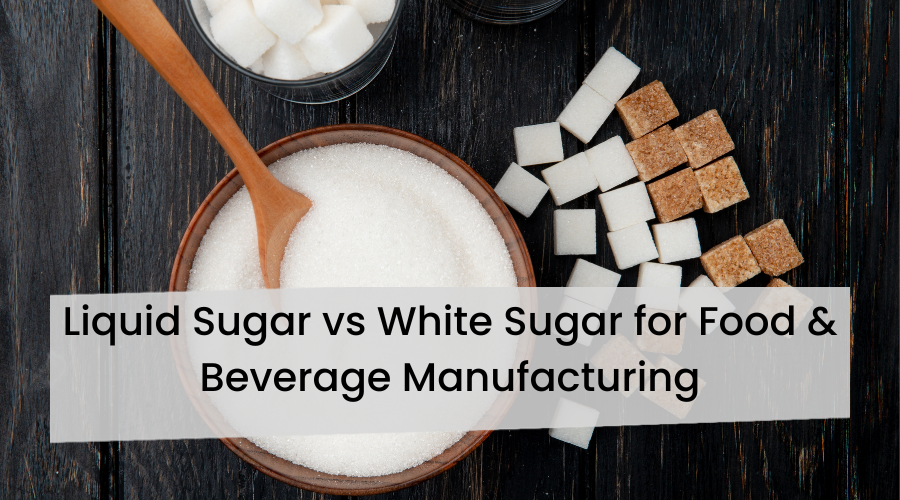
Food and beverage manufacturers face a grave decision to undertake whether to use sweeteners in their products or not. Liquid sugars and white sugar are both popular sweeteners, but differ significantly in their uses.
The knowledge of such differences will help the manufacturing managers determine the best alternative to what they need.
Understanding Liquid Sugar
Liquid sugar refers to concentrated water sugar. A liquid sugar exporter usually supplies products with a sugar content of 60-67% by weight. The solution can be stored at room temperature and can easily go through production systems. Liquid sugar is made by manufacturers dissolving refined white sugar in clean water under controlled conditions. It involves filtration to remove solids and pasteurization to eliminate microbial growth. The product of this is clear, sweet, and ready to be used in production.
Types of Liquid Sugar
The most common type is liquid sucrose, prepared from dissolved white sugar. Compared to ordinary liquid sugar, it is sweeter and has different effects on final products. High-fructose liquid sugar has superior sweetness and alternative functional properties. There are also suppliers of liquid sugar that sell liquid brown sugar, which has a molasses-like taste and color. The types have their own uses depending on the desired level of sweetness and the nature of the product.
Understanding White Sugar
Production and Forms
White sugar or granulated sugar is made of pure crystals of sucrose. This product is distributed by a white sugar supplier in various crystal sizes, ranging from fine to coarse. Refinement eliminates any residual molasses, resulting in the neutral white color and sweet pure taste. The crystalline form enables a long shelf life without any special storage requirements. White sugar is stored in bags or containers at a normal temperature. It is dry, easy to carry, and easy to store in large amounts.
Quality Grades
White sugar is available in varying grades of purity and crystal size. Fine granulated sugar dissolves fast and is appropriate for most baking. Large sugar crystals are good to use as decorations or when one wants to be slow in dissolving. Ultra-fine or super-fine sugar is easy to dissolve, almost instantly, and is therefore beneficial in cold drinks. A white sugar supplier usually has varied grades to suit various manufacturing needs. A brown sugar exporter also sources some of its operations when a molasses flavor is required.
Comparison of Handling and Storage
Liquid Sugar Logistics
Liquid sugar requires specialized storage tanks and temperature controls. Most facilities require stainless-steel tanks with heating mechanisms to maintain appropriate viscosity. Sugar solutions should not corrode the pumps and pipes system. A liquid sugar exporter normally delivers it in bulk tanker trucks linked to storage tanks. This eliminates manual handling but requires infrastructure for receiving. Smaller operations can be supplied with liquid sugar in drums or totes that require various handling equipment.
White Sugar Logistics
White sugar comes in bags, bulk bags, and bulk trucks, depending on the required volume. A distributor of white sugar can serve customers with small bags and entire truckloads. Storage involves using well-ventilated, dry warehouses to prevent moisture absorption. Manipulation of white sugar may include conveyors, elevators, or manual transfer, depending on the size of the facility. Simple equipment is effective because of its dry nature. There is no need to heat or cool the building, which saves on energy.
Storage Life Differences
• Liquid sugar supplied by a liquid sugar exporter normally lasts for months when stored properly. The temperature is controlled, and fermentation and microorganism growth are avoided through clean handling. Regular tank cleaning preserves product quality.
• A white sugar supplier offers white sugar with an indefinite shelf life when it is not moist. The crystal type does not spoil easily during refrigeration or preservation. The long shelf life provides elasticity in the stock management.
Advantages of the Production Process
Liquid Sugar in Manufacturing
• Sugar syrup is dissolved in batches immediately during production. This eradicates the dissolution period of the granulated sugar. The convenience of the ready-to-use enhances faster production and a more uniform distribution of sweetness.
• Liquid sugar is measured easily with automated pumps and flowmeters. It is easier to achieve an accurate dosage with the liquid sugar. The melted shape is incorporated in continuous production lines.
• Liquid sugar is also very useful in the manufacturing of cold beverages. The slow dissolution of granulated sugar in cold liquids poses challenges. A liquid sugar vendor has solutions that are instant in any temperature.
White Sugar in the Manufacturing
• White sugar is useful for its flexibility, such as in dry mixing. The crystalline structure helps in baking operations by aiding texture. Sugar crystals whiten when fats are used and add air during mixing.
• A white sugar supplier provides a product that does not dissolve in the formula when water is added. This is important when moisture levels need to be brought closer to the mark. Dry components are combined, and then liquid additions are added, which provides the formula's flexibility.
• In many applications, the crystallization of sugars and the development of texture require the presence of sugar crystals. Candies, frostings, and some baked products require the physical properties of crystalline sugar. The products of brown sugar exporters offer the same advantages and additional flavor layers.
Cost Considerations
• Liquid sugar is usually more expensive per pound than white sugar. The processing, water content, and highly specialized delivery are also costs. But focusing solely on sugar costs overlooks key elements.
• A white sugar supplier offers a lower price per pound. Facilities should, however, consider the costs of dissolution labor, equipment, and energy. The analysis of the total cost considers all factors, and not only raw materials prices.
Hidden Costs and Savings
Liquid sugar is used to eliminate the need for dissolution equipment and the labor involved. There is also the elimination of energy expenses in mixing and heating water. In most operations, these savings can offset the cost of expensive materials. White sugar needs investment in handling Furniture and dissolution facilities. Mass production requires advanced equipment to dissolve the large amounts of sugar required each day. There is the cost of labor, which increases in the long term. Liquid sugar is preferred for waste reduction. Undissolved sugar crystals may be lost during cleaning processes. A liquid sugar exporter offers a fully dissolved product with no waste from the dissolution process.
Advantages of Quality and Consistency
Liquid Sugar Advantages
• Liquid sugar has an excellent batch-to-batch consistency. All shipments of a liquid sugar exporter are of the same specification. The soluble nature is what gives all production runs the same level of sweetness.
• Pasteurization is effective in increasing microbiological safety. The regulated facility lowers the risks of contamination. Thanks to production, clean closed systems have minimal exposure to airborne contaminants.
• More accurate control systems and measurements are better with liquids. Formulations are regulated automatically with precision to sugar. This consistency implies the similarity in final product quality.
White Sugar Advantages
• Predictable sweetness is associated with pure sucrose content. A white sugar supplier offers a substance with regular chemical characteristics. This purity is important in certain chemical reactions involving sugars.
• The crystalline structure adds functionality to the sweetness. Crystal size influences the finished products' texture, appearance, and mouthfeel. These properties cannot be duplicated with liquid sugar.
• White sugar offers a long shelf life for the formula. Sugar of the same lot could be used to produce products months apart. A brown sugar exporter provides the same stability with added flavor ingredients.
Equipment Requirements
For Liquid Sugar Systems
• Infrastructure is provided with the help of tanks, pumps, and heating systems. Initial cost may be high, particularly in small operations. This will include routine cleaning and periodic equipment replacement.
• Pipe systems should be designed in the right way to avoid the accumulation of sugar. Tracery lines are maintained by heating in coolers. Such systems require ongoing power costs and regular maintenance.
• Dosing is accurate with the use of metering pumps and flow controls. These systems are combined with production equipment through automated controls. High-volume operations are justified by their precision.
For White Sugar Systems
• There is bag-handling equipment, including simple manual and automated bag dumpers. A white sugar supplier can help advise about the systems that can be used, depending on the volume. The investment size depends on production requirements.
• Dissolution tanks need mixing equipment and temperature regulators. Sugar is dissolved in water, heated, and agitated, and then utilized. The sizes are based on production rates and batch Schedules.
• Sugar storage to dissolution or mixing points is done through transport systems. Conveyors, elevators, or pneumatic systems serve various facility layouts. The choice of equipment is a tradeoff between cost, automation level, and convenience.
Factors related to Environment and Safety
Liquid sugar considerations
• Spills result in sticky messes that have to be cleaned up instantly. Liquid sugar makes floors hazardous. These risks are managed by training and equipping employees.
• The cleaning of tanks also produces sugary wastewater that needs to be properly disposed of. Environmental regulations can apply to discharge or disposal. There may be a need for treatment systems in certain places.
• Operation costs include energy used in heating and pumping. The retailer of liquid sugar offers a product that requires continuous energy input. These ongoing costs should be included in the facilities' costs.
White Sugar Considerations
• Handling produces inhalation dangers as well as explosion dangers. Workers and facilities are taken care of by well-ventilated and dust collection systems. Constant cleaning prevents dust from building up.
• The environment should be kept dry so as to avoid clumping and contamination. Climate control systems may be necessary to control the humidity in storage areas. A white sugar supplier usually provides guidance on the correct storage conditions.
• Utilizing water in the dissolution increases utility expenditures. To heat this water, more energy is required. Depending on the quality requirements, this water may require treatment before use.
Making the Right Choice
The volumes of production also play a very important role in making the best decision. The high-volume continuous operations often justify liquid sugar systems. White sugar would be more convenient in smaller batch operations. The type of product defines the best form. Liquid sugar is usually advantageous in beverages. Baking processes usually require crystalline sugar. Other facilities apply both forms to various product lines. The current infrastructure affects implementation costs. A major investment is required to convert white sugar to liquid sugar. A new plant can create systems around a selected form of sugar at the beginning.
Working with Suppliers
Establishment of trust with trusted suppliers creates reliability in quality and service. A liquid sugar exporter should provide technical support and responsive delivery. A white sugar supplier must offer flexible ordering and assured logistics. Other operations handle some specialty goods with a brown-sugar exporter and have white-sugar reserves to produce the normal goods. Numerous supplier relationships provide flexibility and security. The contract terms influence total cost and supply security. Greater commitment can also win better prices. Storage limitations are managed through flexible delivery schedules.
Conclusion
Liquid sugar or white sugar should be used based on production requirements, available infrastructure, and product requirements. All these features of the two forms make them ideal for use in different applications and production scales.
Recent Post
Choosing an edible oil supplier is a decision that directly impacts the profitability of
READ FULLThe global demand for sunflower oil, kernels, and seeds is massive. The farming, cattle,
READ FULL