
.jpg)
Blogs
Selecting The Best Frozen Chicken For Your Needs
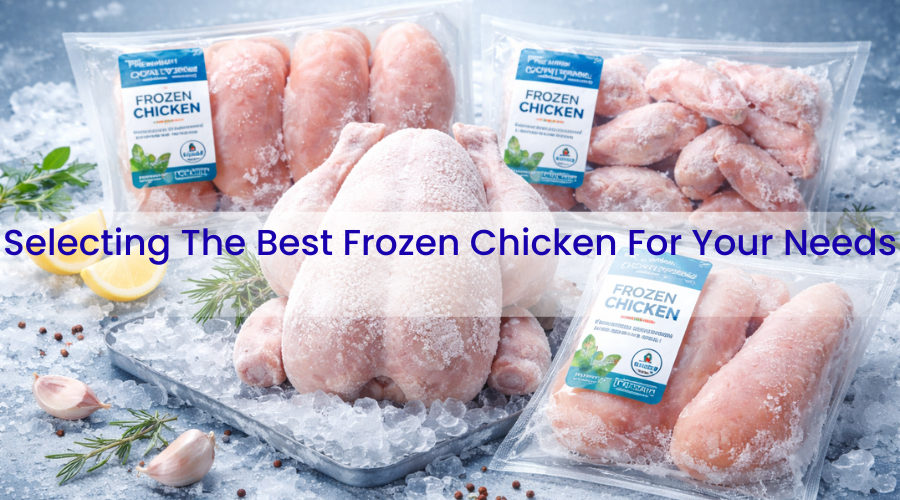
One of the commodities traded worldwide is frozen chicken. It crosses borders in enormous volumes daily. It is not merely a product for bulk buyers, importers, and wholesalers, but a business decision that considers margins, customer satisfaction, and operational efficiency.
However, it is not as simple as it may seem to pick the correct frozen chicken. One can have various cuts, grades, country of origin, and quality standards. Making the wrong choice during the purchasing phase may result in future issues, such as rejected shipments, loss of storage space, dissatisfied clients, and lost revenue.
The guide is dedicated to individuals in bulk procurement. It covers types of cuts, shopping tips, safe storage and handling of frozen chicken, and maximizing purchases.
The reason why Frozen Chicken Dominates the bulk market
The shelf life of fresh chicken is very short. It should deliver to the final customer in a matter of days. It is not very convenient to move it over long distances, particularly abroad. This issue is solved by frozen chicken. Chicken can be stored for months when properly frozen and still retains its nutritional content and eating quality. This makes it viable for large-scale trading, long supply chains, and markets where cold chain infrastructure remains in its early stages.
For wholesalers, frozen chicken is stable in terms of availability. The local seasonal factors are not related to supply. It has made sourcing cheaper through large producers such as Brazil, the United States, Poland, Thailand, and Ukraine, all of which are major exporters of bulk frozen chicken meat in the global market.
The demand is also very high. Frozen chicken is needed by many companies with food services, fast-food chains, meat processing, retail supermarkets, and even by industrial clients. This makes it one of the most dynamic divisions of the international food trade.
Types of Frozen Chicken Cuts
The first thing that a bulk buyer should be aware of is the different cuts to consider. The various buyers require different cuts based on how they consume the product. The following are the key categories:
Whole Frozen Chicken
Whole frozen chickens are washed and later frozen. They sell quite well to retail buyers, butchers, and the market where customers want to cut the chicken the way they want.
Whole birds give importers flexibility. They could either be sold in their original form or disassembled in a local plant. The retailers tend to offer lower prices per kilogram than pre-cut portions, thereby appealing to low-end customers.
Bone-In Cuts
Bone-in cuts are the most popular frozen chicken products in international trade. They include:
• Leg Quarters: the drumstick and the thigh joined together. These are highly marketable in price-sensitive regions of Africa, the Middle East, and sections of Asia. They are cheap and good for meat production.
• Thighs (Bone-In): They are juicier than breast meat because they contain more fat. Commonly used to grill, fry, and slow cook. Good demand in the food service operations.
• Wings: Whole wings or cut up into flats and drumettes. Very high demand in fast food, restaurants, and retail. In some markets, wing prices go up and down depending on the season of demand, especially during major sporting events.
• Breast (Bone-In): Not commonly used but applied in niche food service and retail outlets.
• Drumstick: This is the bottom part of the leg. It has a very high demand for food and retail services.
Boneless Chicken Cuts
The boneless cuts are a more expensive purchase that is in demand among food manufacturers, processed food companies, and food service operations that require ready-to-cook or ready-to-process meat.
• Boneless Skinless Breast: The most commonly used cut of meat everywhere that has healthy consumers and manufacturers. Applied in nuggets, strips, ready meals, and direct cooking. Retail chains and food processors' demand is very high.
• Boneless Skinless Thigh: This is tastier than breast meat. Uses Popular in use in marinades, kebabs, wraps, and available in fast food. In recent years, there has been a great deal of demand.
• Chicken Tenders / Inner Fillets: This is the small piece of meat that is attached to the breast. Used in breaded products, fast foods, and restaurant menu items. Exclusive prices since few birds are produced.
Mechanically Deboned Meat (MDM) and Minced Chicken
MDM is a meat product manufactured by separating meat from bones. It is used in processed foods such as sausages, nuggets, patties, and reformed meat products. Food manufacturers also have minced chicken in frozen blocks.
MDM and minced chicken are key volume-purchased products by buyers in the food processing industry. Prices are reduced per kilogram, but the volumes transacted are very high.
Chicken Feet and By-Products
The chicken feet are a major export product, especially to the Chinese, Southeast Asian, and portions of African markets. They are delicacies in most cultures. Other by-products, such as livers, gizzards, and hearts, are sold frozen and are highly in demand in certain markets.
Strategies to Reflect Before Making a Buying Decision
When the wrong product is sourced, it causes issues that are hard to mend. The following are the main issues to check before making a purchase decision.
Country of Origin and Certifications
This country of origin influences price, quality expectations, import duties, and acceptance of regulations in your target market. Brazil is a major exporter of chicken in the world and has been characterized by competitive prices. The USA also produces large volumes of poultry with good food safety. The EU food safety requirements are strictly enforced in Poland and other EU member states, which makes their products acceptable in markets with very high import volumes.
Ensuring the supplier has the required export licenses for the destination market will always be important. This is a halal certification of the Muslim-dominated locales, health certificates, and the needs of the importing country's veterinary and food safety.
Freezing Method
The quality of products is influenced by the freezing technique. Individual Quick Frozen (IQF) products are frozen one piece at a time, which prevents clumping and makes them easy to portion. Block-frozen products are a number of pieces frozen together as a whole block. IQF tends to be more expensive but easier to use in the food service and retail sectors.
Cold Chain History
Inquire about the product's cold chain history. Is it stored at the correct temperature throughout the operation of processing, storage, and transportation? Any interruption in the cold chain may cause partial thawing and refreezing, hence the deterioration of quality and necessitate food safety risks.
Packaging
Ensure that the package is strong, labeled well, and in accordance with the product. The labels should have the nature of cut, weight, country of origin, the date when the product was processed, date of expiry, and storage directions. For export products, they should be labeled in accordance with the destination country's laws.
Supplier Reliability
Supplier reliability has become the most vital aspect of product quality to bulk buyers and importers. Summarize the history of the supplier. Do they deliver on time? Are their products always in line with the agreed specifications? Do they have the financial strength to manage large orders? References and third-party audits can verify this.
Frozen Chicken Storing and Handling Tips
Half the job is to get the product right. Your storage and handling will determine whether it reaches the end customer in good condition. Inadequate management leads to quality loss, food safety complications, and financial losses.
Do Not Exceed the Right Temperature
Storing will require frozen chicken at or below- 18 degrees Celsius. This temperature will stop bacterial growth and maintain quality. Any increase past this, even in the short term, may start to spoil the product. The cold storage facilities should be kept at peak accuracy in terms of temperature and the alarm system.
First In, First Out (FIFO)
Always use the FIFO system in your cold storage. First-in-first-out should be used to dispatch products. This helps avoid piling up older stock at the back of the shelves, as new stock gets priority. It minimizes the risk of products becoming too close to, or even over, their shelf life whilst in your warehouse.
Refreezing thawed products
Refreezing thawed frozen chicken should be avoided. The alteration of the cellular makeup of the meat provides liveliness in breeding the bacteria, and it also influences the outcome of the frozen food. A qualified food safety professional should assess it when there is a failure in the cold chain, since the shipment might be delivered in a partially thawed condition.
An appropriate Stacking and Storing Pattern
Avoid piling products in your cold storage to block airflow. The cold air must be allowed to circulate freely around the stored goods to achieve a uniform temperature throughout the storage capacity. Create the necessary space between pallets and products and the walls. Overloading leads to uneven cooling, creating warm spots that may compromise quality.
Hygiene in Handling Areas
Frozen chicken should be handled in any area, so loading docks, processing rooms, and windows of dispatch areas should be clean and hygienic. Employee needs to be equipped with the proper work attire. All surfaces that come into contact with the product should be sanitized regularly. There should be no cross-contamination of raw chicken with the other products.
Observe Packaging integrity
Check the packaging, then send any product. Inappropriate packaging subjects the product to contamination and burns. Freezer burn does not render chicken unhealthy to consume, although it has a great influence on the quality and taste of the chicken, which adds to complaints from customers. The spoiled packaging must also be noted during intake and addressed before storage.
Making the Most of Your Frozen Chicken Purchase
Purchasing at high volume has its benefits. However, the benefits can potentially only be realized if you make wise decisions when buying. The following is how to achieve maximum value from every order.
Buy as Per Your Real Demand
When prices are down, there is a temptation to stock up. However, overstocking has its issues, such as increasing storage expenses, the risk of spoilage, and cash tied to the slow-moving stock. Know your sales cycles. Know the fastest-growing cuts in your market. Buy accordingly.
Bring Up Specifications, not Price
Numerous bulk buyers are interested in the purchase at a minimum price. However, the greatest advantage is to have the right specifications at a reasonable price. Discuss the cut size, fat content, percentage of glazing, and the format of the package. A low-priced product that has a high percentage of glaze is paying water weight. These details will save money across all shipments.
Develop Supplier Relationships in the Long-term
Spot buying, buying with other suppliers every time, may appear as a way of saving money. It brings about inconsistency and danger. A stable long-term relationship with a supplier provides you with increased bargaining power, dependable quality, and service. The suppliers also tend to give greater priority to loyal customers when supply is tight.
Diversify Your Sourcing
Simultaneously, reliance on a single supplier or on a country of origin is a source of vulnerability. The supply from a single source can be affected by supply disruptions, export bans, and currency fluctuations. One, two, or three approved suppliers of different origins provide flexibility and minimize risk.
Track Your Losses
Record wastages, damaged goods, and returns. These figures will inform you as to where value is going to waste in the process. If there are high losses at that specific point during intake, storage, or dispatch, probe and correct the problem. When wastage is dealt with in large quantities, even a small saving can make a big difference to overall profitability.
Market prices information
The prices of frozen chicken fluctuate with world supply and demand, feed prices, epidemics, and policies. Well-informed buyers make better decisions as to when to buy, when to hold, and when to bargain more. Track commodity prices and related news, as well as trade magazines in the poultry industry.
Conclusion
Frozen chicken is a high-volume product, such that any decision counts. Knowing your cuts, sourcing through trusted suppliers, and a well-organized inventory are the factors that make the difference between a win and a loss-inducing venture.
Recent Post
Choosing an edible oil supplier is a decision that directly impacts the profitability of
READ FULLThe global demand for sunflower oil, kernels, and seeds is massive. The farming, cattle,
READ FULL